
How Old Is My Dog in Human Years?
Enter your dog's age and size above for a size-adjusted estimate, a comparison with the old 7-year rule, and a science-based formula estimate. The old "multiply by 7" rule is too simple: dogs mature very quickly in the first two years, and large dogs tend to age faster than small dogs after early adulthood.
Dog Years to Human Years Chart
Approximate human-age equivalents by dog size. Large and giant dogs tend to age faster after the first two years, which is why the estimates diverge with age.
| Dog Age | Small (under 20 lb) | Medium (20–50 lb) | Large (50–100 lb) | Giant (over 100 lb) |
|---|---|---|---|---|
| 1 year | 15 | 15 | 15 | 15 |
| 2 years | 24 | 24 | 24 | 24 |
| 3 years | 28 | 29 | 30 | 31 |
| 4 years | 32 | 34 | 36 | 38 |
| 5 years | 36 | 39 | 42 | 45 |
| 6 years | 40 | 44 | 48 | 52 |
| 7 years | 44 | 49 | 54 | 59 |
| 8 years | 48 | 54 | 60 | 66 |
| 9 years | 52 | 59 | 66 | 73 |
| 10 years | 56 | 64 | 72 | 80 |
| 12 years | 64 | 74 | 84 | 94 |
| 15 years | 76 | 89 | 102 | 115 |
Why the 7-Year Rule Is Not Accurate
The idea that one dog year equals seven human years has been common for decades, but veterinarians consider it an oversimplification. There are two main reasons it does not hold up:
- Dogs mature very rapidly early in life. A 1-year-old dog has already reached physical and sexual maturity — closer to a 15-year-old human than a 7-year-old. By age 2, most dogs are fully grown, roughly equivalent to a 24-year-old human. The 7-year rule misses this entirely.
- Aging rate varies by size. After the first two years, small dogs add roughly 4 human years per dog year, medium dogs add about 5, large dogs about 6, and giant dogs about 7. The 7-year rule applies one rate to all dogs of all sizes and all ages, which leads to estimates that can be significantly off.
A common veterinary guideline estimates the first dog year at about 15 human years, the second year at about 9 more, and later years differently by size.
How Dog Size Changes the Estimate
After the first two years, a dog's size is the most important factor in any practical age estimate.
- Small dogs (under 20 lb / 9 kg) age more slowly after early adulthood. They often live longer and may not reach senior life stages until age 10 or later.
- Medium dogs (20–50 lb / 9–23 kg) add roughly 5 human years per dog year after age 2.
- Large dogs (50–100 lb / 23–45 kg) tend to age faster than small or medium dogs. They may reach senior stages as early as age 6–7.
- Giant dogs (over 100 lb / 45 kg) have the shortest typical lifespans among size groups and often reach senior status the earliest — sometimes around age 5.
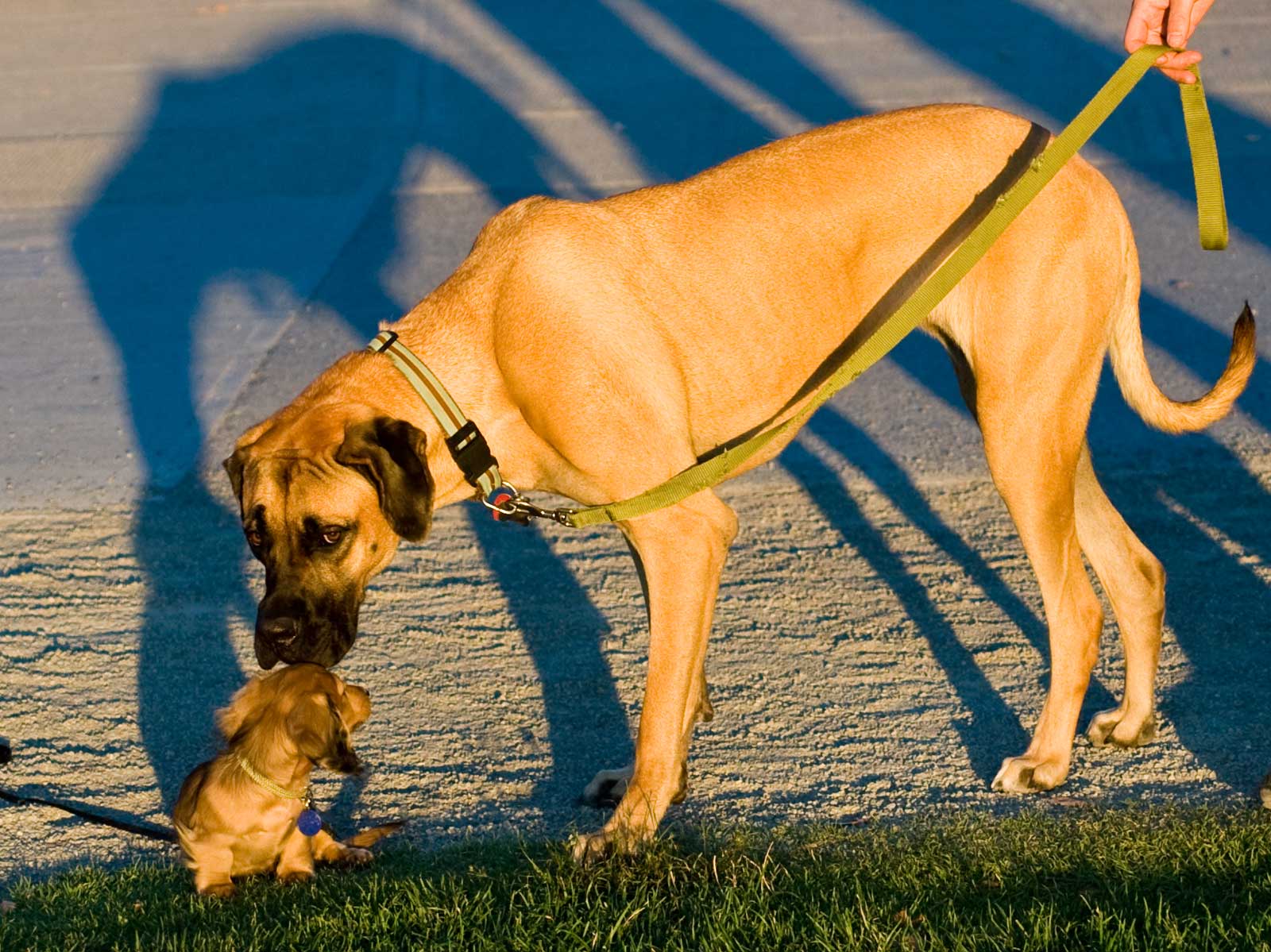
A useful illustration: an 11-year-old Chihuahua may only be entering senior years, while an 11-year-old Great Dane may already exceed the typical lifespan for its size group. The same dog age can mean very different things depending on how large the dog is.
Dog Life Stages by Age
Veterinarians commonly describe dog life in stages. The exact age range for each stage varies by size and breed — there is no single number that applies to all dogs.
- Puppy — Under 1 year. Rapid physical growth and development. Nutritional and care needs differ from adult dogs.
- Young adult — 1–2 years. Dogs reach physical maturity or close to it. Most breeds are fully grown by the end of this stage.
- Adult — Roughly ages 3–6 for most dogs, though this varies by size. Prime adult years with generally stable health needs.
- Senior — Onset varies significantly by size. Large and giant dogs typically reach this stage earlier than small dogs. Senior pets may benefit from age-appropriate nutrition and more frequent veterinary checkups.
- Geriatric — Late senior years. More frequent veterinary monitoring is generally recommended to catch age-related changes early.
Because the senior threshold varies so much by size, use the human-age estimate and the chart above as a general orientation for your dog's life stage, not as a clinical diagnosis.
The Science Formula for Dog Age
A 2020 study published in Cell Systems proposed an epigenetic formula based on DNA methylation patterns — a measure of biological aging at the molecular level. The formula was developed from data that included Labrador retrievers:
Human age = 16 × ln(dog age in years) + 31
About the science formula
This formula produces different results from both the 7-year rule and the size-adjusted calculator. At 1 year: about 31. At 5 years: about 57. At 10 years: about 68.
The formula is shown as the "Science formula estimate" in the calculator results above. Two important caveats: the formula gives very low or zero values for very young puppies (under about 2 months), and it was not validated across all breeds and sizes. Treat it as one scientific reference point rather than a universal answer.
How to Use Your Dog's Age Result
The human-age estimate is an educational and conversational tool, not a clinical measurement. Here is how to read the three numbers the calculator shows:
-
1
The main estimate (Human age equivalent) uses your dog's age and size to apply a size-adjusted aging curve. This is the most practical result for most owners and the one most consistent with common veterinary guidelines.
-
2
The 7-year rule estimate shows what the old formula would give for comparison. For young dogs and for large or giant dogs, the difference from the size-adjusted estimate is usually the most noticeable.
-
3
The science formula estimate applies the epigenetic formula from DNA methylation research. It is most relevant as a scientific reference point for adult dogs.
Related pet calculators
A dog age calculator estimates your dog's age in human years using their real age and size. The old "multiply by 7" rule is too simple because dogs mature quickly in the first two years, and large dogs usually age faster than small dogs.