
How many carbohydrates are in cat food?
Carbohydrate content varies widely depending on food format and recipe. Wet and canned cat foods range from near 0% to about 34% carbohydrates on a dry matter basis. Dry kibble consistently runs between 20% and 35% — starch is needed as a binder during extrusion.
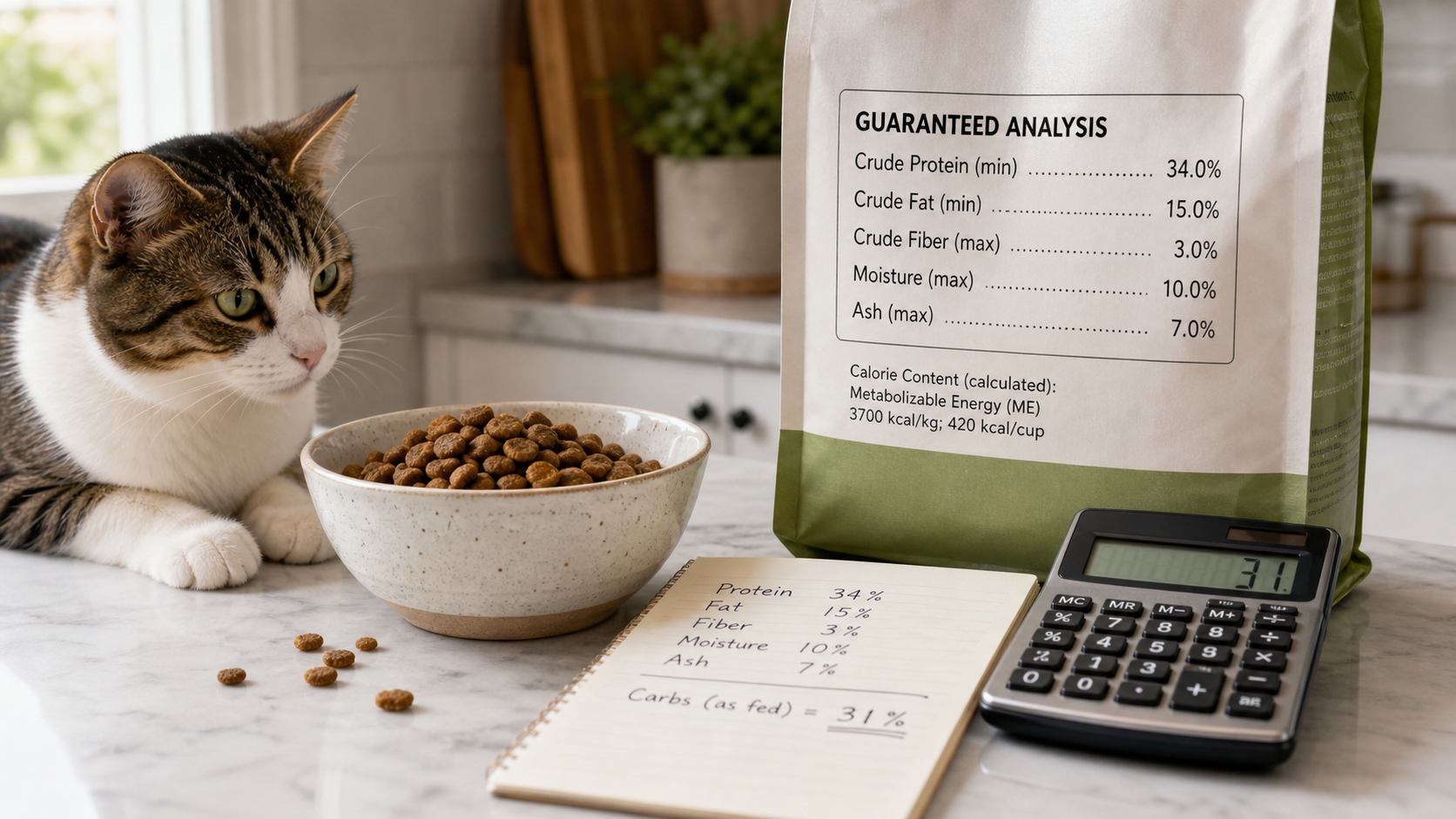
Most labels omit carbohydrates entirely. The standard method is to subtract protein, fat, fiber, moisture, and ash from 100%. The calculator does this automatically and also converts the result to a dry matter basis so you can compare a wet food against a dry food on the same basis.
Why dry matter carbs matter
A wet food that shows 4% carbs as fed can actually be 18% on a dry matter basis once moisture is removed from the calculation. A dry food at 28% as fed sits at around 31% dry matter. Without the dry matter conversion, the moisture difference makes wet foods appear much lower in carbs than they actually are.
How the calculation works
Carbs as fed (%) = 100 − protein − fat − fiber − moisture − ash
Dry matter carbs (%) = carbs as fed ÷ (100 − moisture) × 100
Example: a wet food with 10% protein, 5% fat, 1% fiber, 78% moisture, 2% ash gives 4% carbs as fed and about 18.2% dry matter.
What values to enter from the label
| Label value | Why it matters |
|---|---|
| Crude protein | Primary nutrient fraction; subtracted from 100%. |
| Crude fat | Second major macronutrient on the label. |
| Crude fiber | Listed separately; not the same as total carbohydrates. |
| Moisture | High in wet food (~78–82%); drives the dry matter conversion. |
| Ash (minerals) | Ask the manufacturer if it's not printed; don't guess if precision matters. |
Step-by-step
-
1
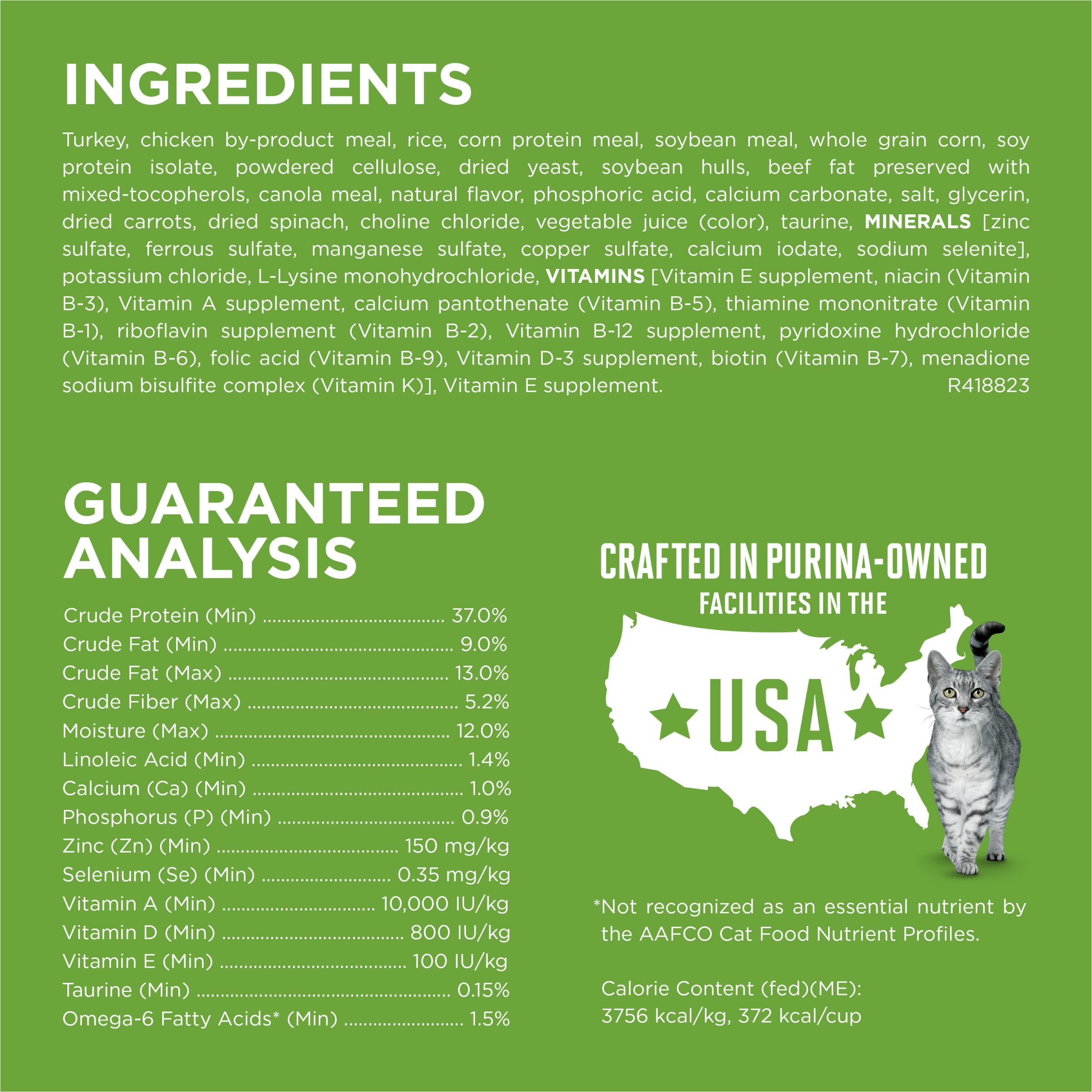
Find the Guaranteed Analysis panel on the package or manufacturer website.
-
2
Enter protein, fat, fiber, moisture, and ash into the calculator.
-
3
Read carbs as fed — the carbohydrate level in the food as served.
-
4
Read dry matter carbs to compare this food against any other format.
-
5
For medical or diabetic diets, verify with manufacturer typical analysis and your vet.
Carbohydrate levels in commercial cat foods
The tables below show estimated dry matter carbohydrate levels for wet and canned adult cat foods. Dry matter basis makes the comparison fair across foods with very different moisture levels.
All dry cat foods are excluded — they all fall between 20% and 35% DM carbs due to the extrusion process. Foods that don't disclose enough nutrients to calculate carbs (Whiskas, Dine, Feline Natural, Fussy Cat) are also excluded.
Carb levels in adult cat foods (wet/canned, % dry matter)
| Cat food | Carbs % DM | |
|---|---|---|
| Holistic Select Chicken Pâté tin | ~0 ** | |
| Holistic Select Turkey & Salmon Pâté tin | ~0 ** | |
| PRO PLAN Adult Salmon & Rice Entrée tin | ~0 ** | |
| PRO PLAN Adult Chicken & Liver Entrée tin | 2.3 | |
| PRO PLAN Ocean Whitefish & Salmon Entrée | 2.3 | |
| Holistic Select Salmon & Shrimp Pâté tin | 4.6 | |
| Holistic Select Chicken Liver & Lamb Pâté tin | 6.4 | |
| Holistic Select Turkey Pâté Recipe tin | 6.8 | |
| Royal Canin Instinctive Adult in Jelly | 8.0 | |
| Fancy Feast Chicken & Giblet Pâté tin | 9.0 | |
| Fancy Feast Petit Cuisine (many varieties) | 9.0 | |
| Holistic Select Ocean Fish & Tuna Pâté tin | 9.1 | |
| PRO PLAN Adult Chicken Entrée tin | 9.1 | |
| Fancy Feast Cod | Sole & Shrimp tin | 13.6 |
| Fancy Feast Gravy Lovers tins (2 varieties) | 13.9 | |
| Elevate Adult Healthy Weight pouches | 14.0 | |
| Fancy Feast 'Feast In Gravy' (many varieties) | 14.0 | |
| PRO PLAN Adult Chicken & Rice Entrée tin | 14.0 | |
| PRO PLAN Adult Tuna Entrée tin | 14.0 | |
| Purina Fancy Feast pouches (many varieties) | 14.0 | |
| Royal Canin Instinctive Adult in Loaf * | 15.5 | |
| Purina Fancy Feast Inspirations pouches * | 15.9 | |
| Purina Felix pouches (many varieties) * | 16.8 | |
| PRO PLAN Adult Turkey & Giblets Entrée tin | 17.3 | |
| Fancy Feast Cheddar Delights tins (2 varieties) | 17.5 | |
| PRO PLAN Adult Beef Entrée with Carrots tin | 17.5 | |
| PRO PLAN Salmon Entrée with Wild Rice tin | 17.5 | |
| Veganpet Vegan Cat Food tins | 19.2 | |
| Ziwi Peak tins (all varieties) | 20.5 | |
| Felix Sensation Jellies (many varieties) | 21.0 | |
| Fancy Feast Roast Chicken / Carved Beef | 21.8 | |
| Royal Canin Instinctive Adult in Gravy * | 22.3 | |
| Hill's Hairball Control Savory Chicken | 24.9 | |
| Hill's Salmon Tender Chunks in Gravy | 28.3 | |
| Hill's Tender Tuna Dinner tin | 28.9 | |
| Hill's Savory Turkey Entrée tin | 29.3 | |
| Hill's Tender Chicken Dinner tin | 29.8 | |
| Hill's Ocean Fish Entrée tin | 30.2 | |
| Hill's Ocean Fish Tender Chunks in Gravy | 30.4 | |
| Hill's Seared Tuna & Carrot Medley tin | 31.1 | |
| Hill's Chicken Tender Chunks in Gravy | 32.5 | |
| Purina Friskies pouches (many varieties) * | 34.1 | |
| Hill's Roasted Chicken & Rice Medley tin | 34.4 |
* Moisture was not declared on the label; an average value of 78% was used in the calculation.
** These three foods have declared nutrients that already add up to 100% or more before carbohydrates are counted. Actual moisture is likely lower than the maximum figure on the label. Treat these as effectively zero-carb but verify with the manufacturer.
Carb levels in kitten cat foods (wet/canned, % dry matter)
| Kitten cat food | Carbs % DM |
|---|---|
| PRO PLAN Kitten Chicken & Liver Entrée | 2.1 |
| Fancy Feast Kitten Whitefish Feast tin | 4.6 |
| Royal Canin Kitten Instinctive in Loaf * | 10.9 |
| Hill's Kitten Liver & Chicken Entrée tin | 15.0 |
| Royal Canin Kitten Instinctive in Jelly * | 16.4 |
| Royal Canin Kitten Instinctive in Gravy * | 17.7 |
| Hill's Kitten Tender Chicken Dinner tin | 19.2 |
| Hill's Kitten Roasted Chicken & Rice Medley | 28.9 |
* Moisture not declared; 78% average used. The kitten food market has far fewer wet options — many brands only publish dry kitten foods.
Carbs as fed vs dry matter carbs
| Result | Best use |
|---|---|
| Carbs as fed | Understanding the food as served from the can or pouch. |
| Dry matter carbs | Comparing wet food against dry food or across brands with different moisture levels. |
What if ash is not listed?
Some labels omit ash. The best option is to contact the manufacturer for their typical analysis. If you use a placeholder (2% for wet food, 7–8% for dry food), the result becomes less reliable — useful for rough screening but not for precise dietary management.