
Cat calorie formula
RER = 70 × weightKg^0.75
MER (maintain) = RER × age × neuter × activity × body condition
MER (lose weight) = RER × 0.8
MER (gain weight) = RER × 1.8
Factors used by the calculator
| Factor | Option | Value |
|---|---|---|
| Age stage | Adult | 1.0 |
| Age stage | Senior or lower metabolism | 0.95 |
| Age stage | Kitten 4 to 12 months | 2.0 |
| Age stage | Kitten under 4 months | 2.5 |
| Neuter status | Neutered or spayed | 1.2 |
| Neuter status | Intact adult | 1.4 |
| Activity | Less active or obesity-prone | 0.8 |
| Activity | Typical indoor cat | 1.0 |
| Activity | Active indoor or outdoor access | 1.2 |
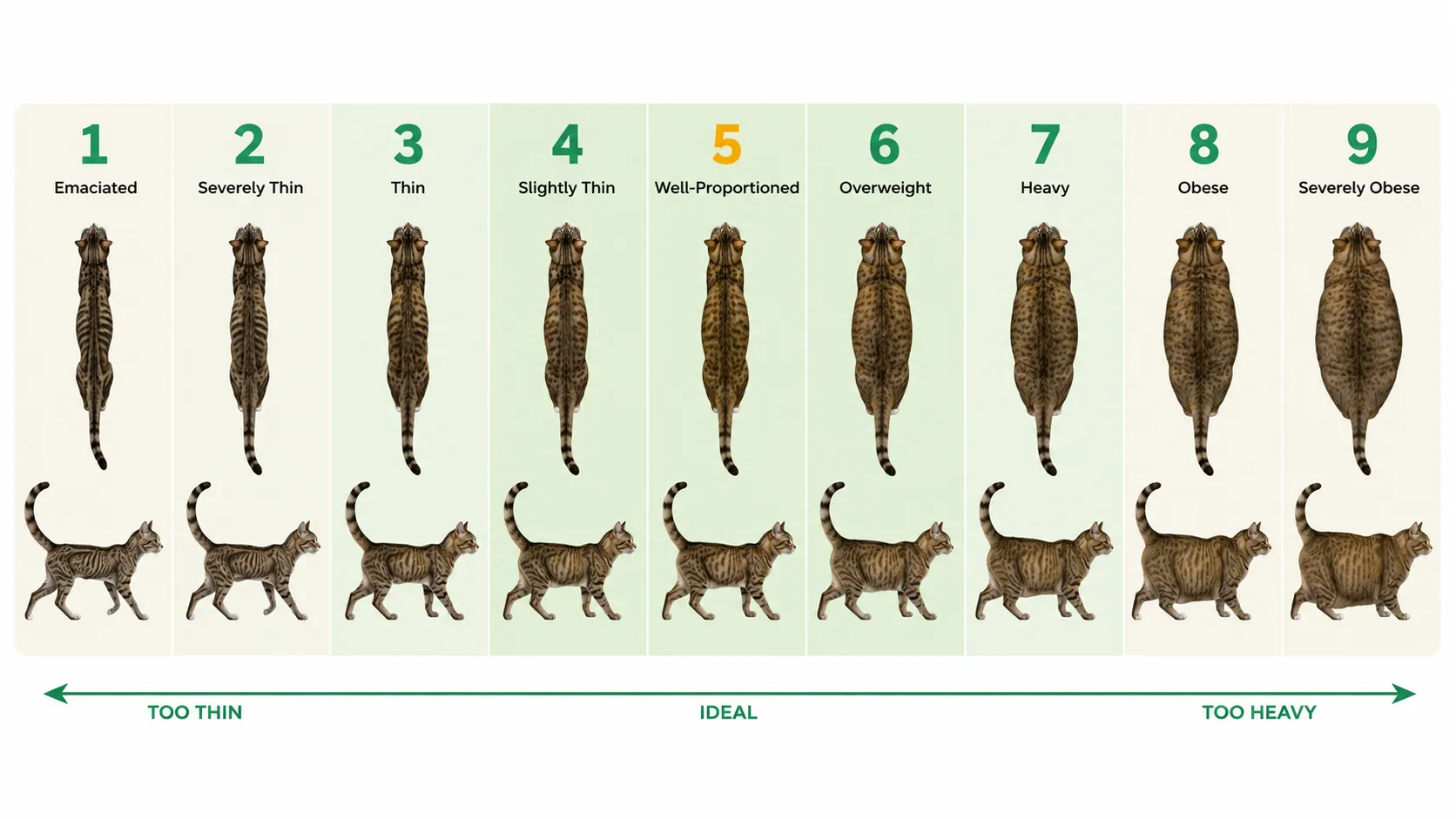
| Body condition | Underweight | 1.1 |
| Body condition | Ideal weight | 1.0 |
| Body condition | Overweight | 0.9 |
| Body condition | Obese | 0.85 |
| Goal | Lose weight | 0.8 × RER (overrides all factors) |
| Goal | Gain weight | 1.8 × RER (overrides all factors) |
What RER and MER mean
RER is the resting energy requirement, the estimated calories a cat needs for basic body functions at rest. It is calculated from metabolic body weight using the formula 70 × weightKg^0.75. This formula scales more accurately across different body sizes than a simple calories-per-pound rule.
MER is the maintenance energy requirement. It adjusts RER for real-world factors including life stage, neuter status, activity level, and body condition. Most adult neutered indoor cats have an MER between 1.0 and 1.4 times their RER. Kittens and highly active cats need significantly more.
These are commonly used veterinary estimating factors, not universal standards. The Ohio State University Veterinary Medical Center notes that individual needs can vary by roughly 50 percent from calculated values, so adjust the feeding amount based on your cat's actual weight changes over time.
How many calories should a cat eat by weight?
| Weight (lb) | Weight (kg) | RER (kcal/day) | Estimated daily calories |
|---|---|---|---|
| 5 lb | 2.3 kg | 131 | 157 |
| 8 lb | 3.6 kg | 183 | 220 |
| 10 lb | 4.5 kg | 216 | 259 |
| 12 lb | 5.4 kg | 248 | 298 |
| 15 lb | 6.8 kg | 295 | 354 |
How many treat calories can my cat have?
The calculator shows the 10 percent treat limit as the max treat calories result. For a cat needing 250 kcal/day, that is about 25 kcal from treats.
When giving treats, count them within the daily total rather than adding them on top. Most commercial cat treats list calorie content on the label or the manufacturer website. High-treat diets can push cats into a calorie surplus unnoticed, especially less-active indoor cats.
Current weight or ideal weight?
For a cat at a healthy body condition, use current weight. For a cat that needs to lose weight, veterinarians typically calculate the calorie target using the cat's target or ideal weight rather than current weight. If your vet has given you a goal weight, enter that value in the calculator with the lose weight goal selected.
How to convert calories into cups or cans
Once you know your cat's daily calorie need, divide by the calorie density of your food to estimate the daily portion. For example, if your cat needs 230 kcal/day from food (after subtracting 10 percent for treats) and your dry food has 380 kcal per cup, the daily amount is roughly 230 ÷ 380 ≈ 0.6 cups per day.
The optional food calorie density field in the calculator above does this automatically. Enter the kcal per cup or kcal per can from your food label, and the daily food portions result will update.
Calorie density varies widely between brands and formats. Wet food typically ranges from 20 to 40 kcal per ounce; dry food typically ranges from 300 to 500 kcal per cup.
How to use the cat calorie calculator
-
1
Weigh your cat or use a recent veterinary weight. For a weight loss plan, ask your vet for a target weight and enter that value.
-
2
Select the closest age stage. Adult covers most cats from 1 to 7 years. Use Senior for older or lower-metabolism cats.
-
3
Select neuter status and body condition. Body condition adjusts the coefficient slightly for maintain goal. Lose or gain goal overrides the full coefficient.
-
4
Choose activity level. Typical indoor is the most common starting point. Adjust down for very sedentary cats or up for cats with regular outdoor access.
-
5
Set meals per day to see the calorie split per meal. Optionally enter your food's kcal per cup or can to get an estimated daily food portion.
-
6
Use the estimated daily calories as a starting point. Recheck body condition and weight every 4 to 6 weeks and adjust the feeding amount with your veterinarian's guidance.
When to adjust the estimate with veterinary guidance
- Weight loss or weight gain programs, especially for obese cats.
- Kittens, pregnancy, or nursing mothers.
- Diabetes, kidney disease, hyperthyroidism, inflammatory bowel disease, or other chronic conditions.
- Any cat whose weight or body condition has changed unexpectedly.
- Cats on prescription or therapeutic diets with specific feeding instructions.